


Black Mass and the Battery Revolution: An Overview of Experimental Research Conducted by Alfred H Knight
As the global demand for batteries is projected to increase significantly in the coming decades, Alfred H Knight, a leading global testing and inspection organisation, is participating in the ‘battery revolution’ through innovative experimental research.
As we enter the ‘battery revolution’ era, the number of lithium-ion batteries (LIB) in circulation is likely to increase significantly.
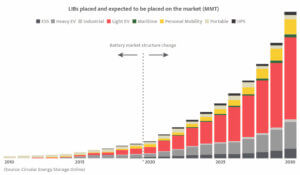
Some investigators predict that an anticipated shortfall in the availability of battery minerals will result in a greater reliance on recycling end-of-life (EoL) LIBs.
Experimental research commissioned and conducted by Alfred H Knight and our partners explores the phase characteristics of the commercially important intermediate material, known as ‘black mass.’
WHAT IS BLACK MASS?
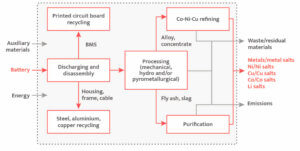
‘Black mass’ is the industry term used to describe a type of e-waste comprising crushed and shredded EoL battery cells. It contains mixtures of valuable metals including: lithium, manganese, cobalt and nickel.
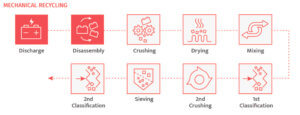
Initially, waste batteries are collected, sorted, discharged and disassembled.
Subsequently, they are crushed mechanically, dried, sorted, sieved, and pyrolysed to 700°C. This is done to remove any remaining electrolyte and potentially hazardous, fluorine-containing components. The resulting material is what is referred to in the battery recycling industry as ‘black mass’.
The demand for future battery minerals supply and associated metals relies on the availability of economically viable geological raw materials. Additionally, the recycling market for LIBs is expected to experience significant expansion. Therefore, black mass could provide strategically important metal resources that could make up part of the shortfall from conventional geological supplies. Hence, the shift to a more circular economy creates the framework needed for collecting and recycling LIB into the supply chain.
According to Circular Energy Storage, by 2030, it’s estimated that around 1.2 million tonnes of LIBs will have reached EoL. This comprises an estimated potential recovery of 125,000 tonnes of lithium, 35,000 tonnes of cobalt and 86,000 tonnes of nickel, which could be recovered for use in new battery production.
PHASE CHARACTERISATION
The results of the assaying performed by Alfred H Knight found a sample of black mass from a European source to comprise: cobalt (15.79%), nickel 6.94%, manganese 4.82%, lithium 3.19%, copper 1.97%, aluminium 5.13% and other components.
Following this, the AHK Technical Department commissioned an innovative and experimental programme of ‘phase characterisation’. The aim was to determine the battery components, phase chemistry, morphological characteristics, grain size, composition, and textural variability of a natural state (unprepared) and prepared (crushed and dried) powdered sample.
This was required to develop a sampling strategy and standard operating procedure (SOP) to obtain a non-biased and representative sample. It also assisted in determining a hydrometallurgical or pyrometallurgical processing route, detecting valuable payable metals, assisting with assay procedures, identifying potential pollutant or penalty phases, and for hazard identification and risk mitigation.
The black mass was investigated using expertise and instruments from the UK, Canada and Finland. This included:
- A visual examination and binocular microscopy.
- Manual scanning electron microscopy (SEM).
- Automated scanning electron microscopy with linked energy dispersive spectrometers (SEM-EDS).
- Advanced mineral identification and characterisation systems (AMICS).
- X-ray computed tomography (X-CT).
- Laser ablation inductively coupled plasma mass spectrometry (LA-ICP-MS).
THE RESULTS
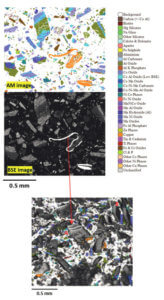
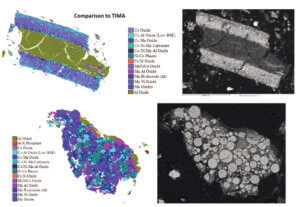
The results of the automated and interactive SEM-EDS quantified the phases present. They showed at high resolution, the chemical variability and phases present that could be assigned to original battery components:
- The particles were found to be texturally complex, with mixed phases.
- Aluminium foils were coated with the different lithium metal oxide compounds.
- Copper foil appeared ‘wire-like’ in 2D. However, the X-CT imaging showed complex 3D textures and morphology of the particles, including deformed copper foil sheets.
- The light elements, such as lithium and 67 other non-metals and metals, were detected and quantified at a 20-micron scale with detection limits ranging from ppm to ppb using LA-ICP-MS.
WHY IS THIS IMPORTANT?
The technical research commissioned and conducted by Alfred H Knight provides a detailed understanding of the complex composition, particle structure and textural variability of black mass. As a result, this enables improved sampling and analysis techniques, supporting a comprehensive understanding of the metal content. Accordingly, Alfred H Knight is providing a more detailed understanding of black mass in the recycling industry. This helps with understanding industrial processing and the recycling of battery waste.
SPEAK TO AN EXPERT IN BLACK MASS AND BATTERY RECYCLING
Our highly skilled subject matter experts, technical specialists, field inspectors, and laboratory technicians operate from strategically located hubs around the globe. This enables us to deliver swift, accurate and reliable results at each stage of the battery materials supply chain.

For further information on this research or to discuss your end-of-life batteries, head to our contact page.
ACKNOWLEDGEMENTS
The author would like to acknowledge the support and contributions from: Prof Duncan Pirrie (University of South Wales), Dr Matthew Power (Vidence Inc., Canada), Dr Ian J Corfe, Dr Jukka Kuva, Dr Sari Lukkari, Dr Yann Lahaye, Dr Xuan Liu, Dr Alan Butcher (Geological Survey of Finland, Circular Economy Solutions Unit), IUGS Initiative on Forensic Geology (IFG), AHK Technical Department, AHK Communications and Marketing Department, Mr Patrick Le Mare (AHK Circular Economy Industry Lead), Mr Theodoros Theodorou (formerly, AHK Senior Market Analyst, Circular Economy), Mr Seok Han (AHK battery specialist).
This article was originally featured in the Q2 2022 Rho Motion Magazine. To read the rest of the magazine, request a digital copy here.