


Biomass Fuel Quality: Are Your Sampling Procedures Fit For Purpose?
Biomass already contributes around 14% of the UK’s renewable energy mix, and demand for clean, consistent fuel is only set to rise as the UK moves towards net-zero.
To meet sustainability targets and keep plants running efficiently, it’s essential to understand the true quality of your biomass fuel. But accurate fuel data doesn’t just start in the lab.
SAMPLING: WHY DOES IT MATTER FOR BIOMASS FUEL QUALITY?
Biomass sampling isn’t as simple as just taking a handful of material from a pile. To be truly representative, a sample needs to reflect the entirety of the lot, not just a portion.
That requires careful planning, understanding the characteristics of your fuel, and following a process that reduces uncertainty and bias.
BIOMASS SAMPLING BEST PRACTICES: WHAT SHOULD YOU CONSIDER?
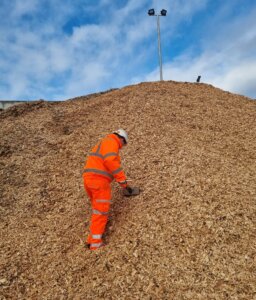
While lab analysis is often seen as the most important step, the quality of biomass sampling and sample preparation is what makes any analysis meaningful. Getting it right means focusing on:
- Definition of the lot and sub-lot size
- The state of the material (static or in motion)
- Top and bottom particle size
- Sampling tools and techniques
- Frequency, increment volume and method
- Process characteristics and variability
Standards like ISO 18135 and ISO 21945 offer default values, but a measured approach is more effective. That’s where PIV (Primary Increment Variance) and PTV (Preparation and Testing Variance) come in.
PRIMARY INCREMENT VARIANCE (PIV)
PIV measures variability between individual increments from a lot. In short, it shows how consistent, or inconsistent, your biomass is across the whole batch.
High PIV = Heterogeneous material (increase sampling increments and divide into sublots).
Low PIV = Homogeneous material ( fewer increments may be sufficient).
Understanding PIV allows you to tailor your sampling to your material, giving more accurate insights for quality control, process optimisation, and reporting.
PREPARATION AND TESTING VARIANCE (PTV)
Even with correct sampling, variability can occur during preparation, especially with heterogeneous fuels.
PTV measures how grinding, splitting, moisture control, and handling affect your test results. High PTV can distort test outcomes and reduce consistency. Minimising PTV helps:
- Improve repeatability
- Optimise performance and handling
- Ensure confidence in results
DEFINE SAMPLING BY MEASUREMENT, NOT ASSUMPTION
Combining PIV and PTV allows you to set sampling criteria based on data, not assumptions. This strengthens confidence in results, provides a solid foundation for compliance, and contributes to informed regulatory or commercial disputes.
THE ROLE OF BIAS TESTING
Bias testing is a vital but often overlooked method to detect systematic errors in sampling.
Typically used with mechanical systems, it compares paired samples, one from the system, one from a trusted reference method. Sample preparation and analysis are then performed for the chosen test parameter, and the results are statistically reviewed for bias.
Bias testing can also be applied to manual methods, especially in audits or disputes. If performed regularly, it improves confidence in your sampling process and, by default, confidence in analytical results.
BIOMASS AUDITING
Accurate biomass sampling isn’t just about test data; it’s also key to meeting standards and contract terms. Auditing helps close the gap between current practices and requirements under ISO 18135 and ISO 21945. It supports:
- Consistent, replicable procedures
- Identification of non-compliance
- Contractual alignment
- Traceability across sites or supply chain stages
Inspections also assist in resolving disputes by providing a clear record of how samples were taken and prepared.
Routine audits, internal or third-party, reinforce procedures, demonstrate due diligence, and help maintain long-term performance.
WANT BETTER BIOMASS FUEL QUALITY DATA?
Better sampling means better data and smarter decisions. Whether you’re validating existing systems or rethinking your sampling approach, our experts can help.
Get in touch via our contact page to speak to a specialist or arrange a biomass sampling audit. Visit our biomass services page to learn more.