


Simpler Recycling and MRF Code of Practice: How will your waste operations be affected?
The UK waste and recycling landscape is entering a period of significant change. Two government-led reforms, the updated MRF Code of Practice (MRF CoP) regulation and the rollout of Simpler Recycling legislation, are reshaping how materials recovery facilities will manage materials, monitor contamination, conduct waste composition analysis, and report outcomes.
For MRF managers, understanding how these two obligations work together is key to staying compliant, competitive, and prepared.
WHAT IS SIMPLER RECYCLING?
The Simpler Recycling reforms, introduced by Defra, aim to standardise household and non-household recycling collections across England. Once implemented, local authorities and businesses will be required to collect a core set of materials, including:
- Paper and card
- Plastic packaging
- Metal packaging
- Glass
- Food waste
- Garden waste (for households)
The goal is to improve consistency, reduce contamination, and make it easier for residents and businesses to recycle correctly. Ultimately, this will increase material quality and drive a more efficient circular economy.
WHAT IS THE MRF CODE OF PRACTICE?
The MRF (Materials Recovery Facility) Code of Practice Regulation outlines the procedures for sampling, measuring, and reporting the quality of both input and output materials. Facilities that process more than 1,000 tonnes of mixed dry recyclables annually are required to:
- Conduct regular and representative sampling
- Measure contamination levels and conduct waste composition analysis to understand material breakdown
- Submit data in the required format to the Environment Agency
- Demonstrate compliance through analysis
The updated CoP strengthens the focus on transparency and material quality, placing greater emphasis on robust, auditable sampling practices.
HOW THE TWO REGULATIONS INTERCONNECT
These reforms are closely linked. Simpler Recycling governs what is collected, while the MRF CoP governs how it is assessed. Together, they create a joined-up compliance framework:
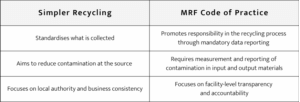
Operators must ensure they are both receiving the right materials and managing them to the required standard, supported by accurate monitoring, waste composition analysis, and reporting.
PREPARING FOR COMPLIANCE
With the MRF Code of Practice already in force and Simpler Recycling due for rollout by March 2026, now is the time to review your current practices.
Ask yourself:
- “Are your sampling procedures CoP-compliant?”
- “Can you accurately report on contamination levels?”
- “Are you ready for increased scrutiny on material quality?”
If you’re unsure, Alfred H Knight can help you identify gaps and implement a clear plan forward.
WHERE ALFRED H KNIGHT CAN HELP
With decades of experience in waste sampling, independent testing, and materials analysis, Alfred H Knight supports organisations across the full waste journey from collection through to compliance.
We help MRFs, reprocessors, and waste handlers to:
- Design and implement sampling plans that meet the MRF Code of Practice
- Measure composition, moisture content, and contamination levels
- Independently verify materials to support data submissions
- Prepare for Simpler Recycling reforms through baseline testing, waste composition analysis, and contamination monitoring
SPEAK TO AN AHK EXPERT TODAY
As the regulatory landscape evolves, Alfred H Knight is here to help you navigate the changes and demonstrate the quality of your operations.
Contact us today to speak with an expert about your compliance needs (including waste composition analysis and sampling strategies). Otherwise, explore our range of services to see how we can support your organisation.